
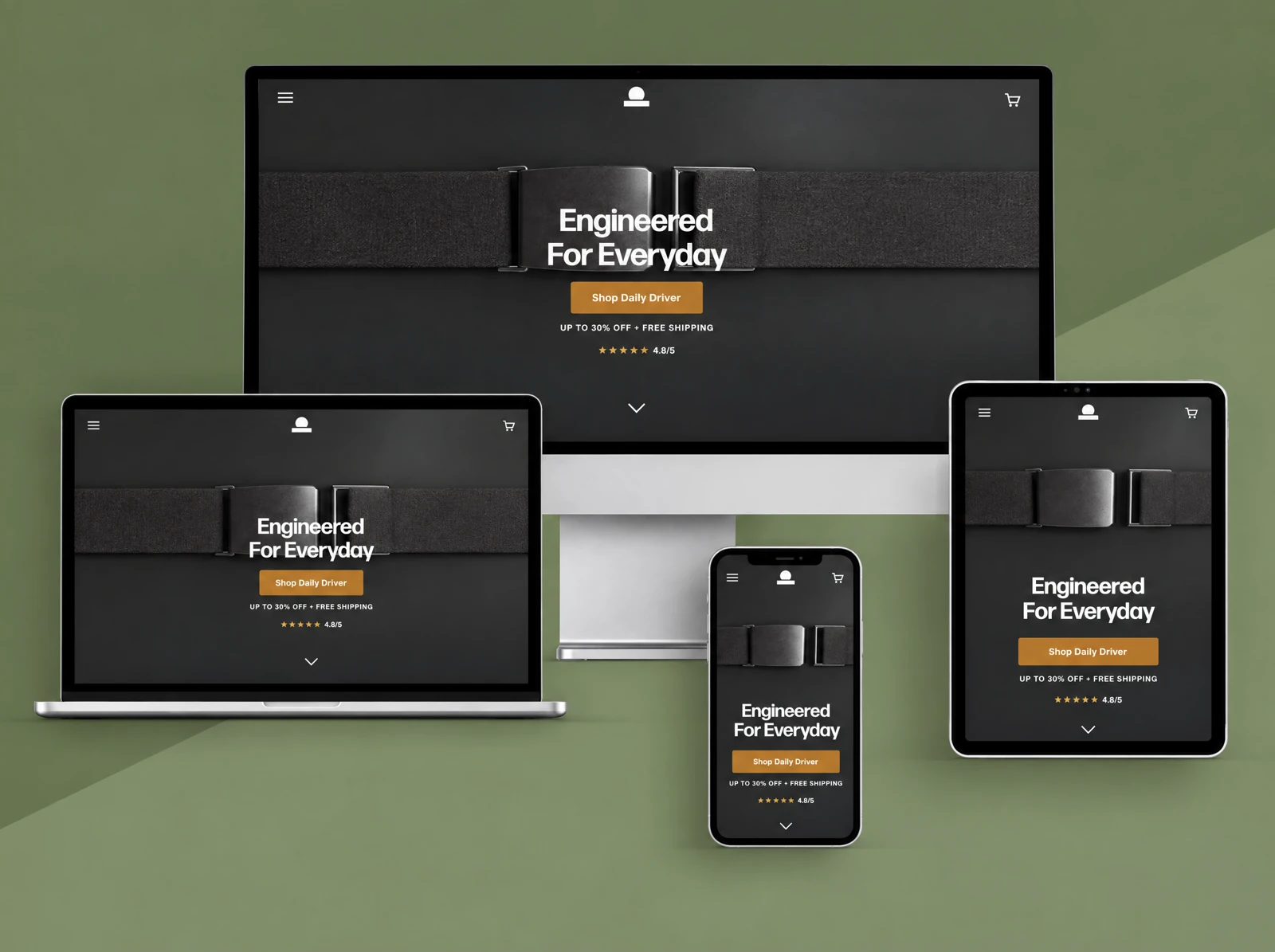
01 / Daily Belts
The challenge: a buying decision inside the product page
The main issue on Daily Belts was multiple-quantity selection on the product detail page, often called the PDP. This placed the focus of the engagement close to the purchase decision: how a shopper chooses the amount they want before continuing to the cart. The work was concerned with that interaction as well as the overall storefront design.
A quantity control may occupy only a small part of a page, but it carries an important responsibility. The shopper needs to understand the current selection and feel confident about what happens next. If that step is difficult to follow, visual polish elsewhere cannot make the purchasing journey clear. That is why this case study centres on a specific interaction rather than presenting the project as a purely cosmetic redesign.
02 / Daily Belts
My contribution: Figma to Shopify with a CRO focus
My contribution included translating Figma designs into Shopify and working on conversion rate optimization. These were connected parts of the brief: the design established the visual direction, while the CRO focus gave the implementation a practical purpose. The multiple-quantity selection issue on the product page was the central challenge within that work.
For a project like this, implementation has to account for more than a static design frame. A product page has selection states, purchase controls, changing content, and different screen sizes. My development approach is to consider the intended customer action alongside the layout, so that decisions about spacing, emphasis, and interaction serve the same buying journey.
03 / Daily Belts
Why quantity selection deserves careful attention
The useful question is whether a shopper can understand and complete the selection without needing to interpret the interface. For similar Shopify work, I review the relationship between the quantity control, the product information, and the next purchase action. I also look at how the control feels on a small screen, where a compact layout can make an otherwise straightforward decision harder.
A sensible verification plan follows the selection through to the cart, including changes made before adding a product. It also considers keyboard access, visible feedback, and the space available for touch controls. These are the kinds of checks that make the intended interaction reviewable; they are not a claim that a particular experiment or measured conversion uplift has been published for Daily Belts.
04 / Daily Belts
Speed optimization is ongoing
Speed optimization is also part of the Daily Belts engagement and remains ongoing. The goal is to support a responsive shopping experience alongside the design and CRO work. A page that looks finished still needs attention to the resources and interactions involved in loading and using it.
For performance work, my approach is to establish a baseline, identify the main sources of delay, and compare the same important pages after changes. The buying experience must continue to work throughout that process. No before-and-after speed scores or conversion figures are published here, so the ongoing performance work should not be read as a completed numerical result.
What this work illustrates
This project illustrates how I connect Figma to Shopify development with a concrete commerce problem. The confirmed scope is design implementation, CRO with a focus on multiple-quantity selection, and ongoing speed optimization. It is relevant to teams that need a developer to look beyond the page design and consider how people actually buy.
This account describes my contribution and development approach. Quantified results are not published; speed optimization remains ongoing.